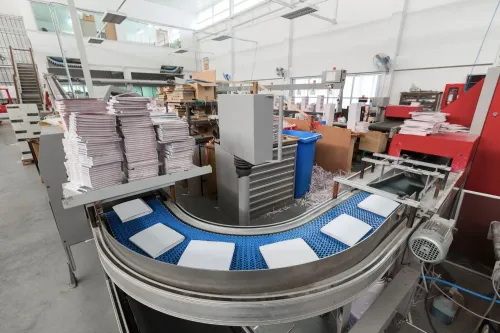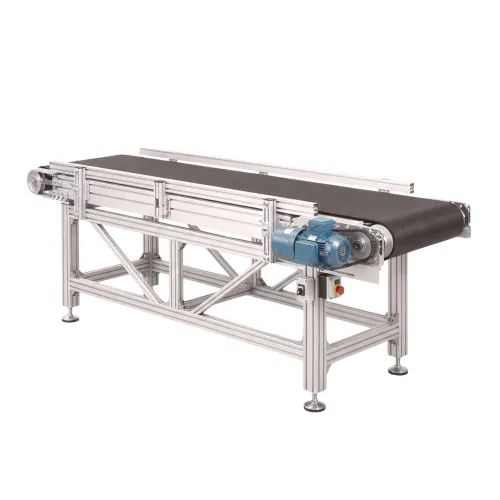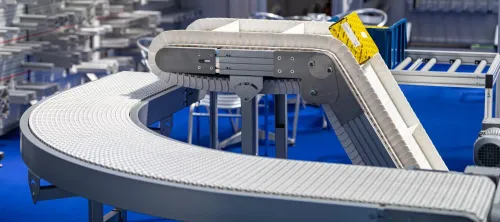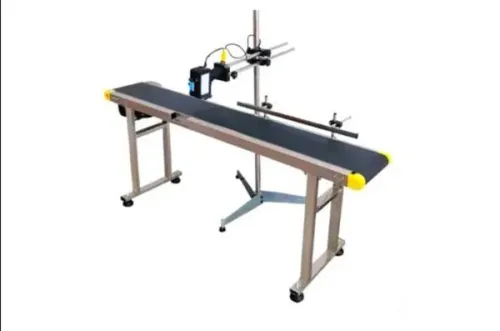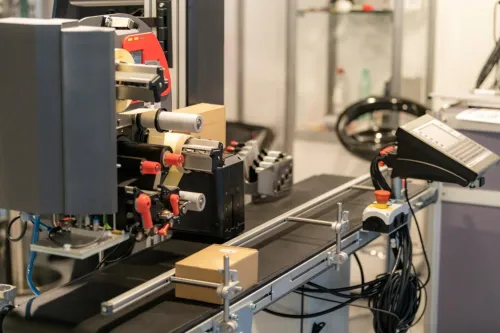
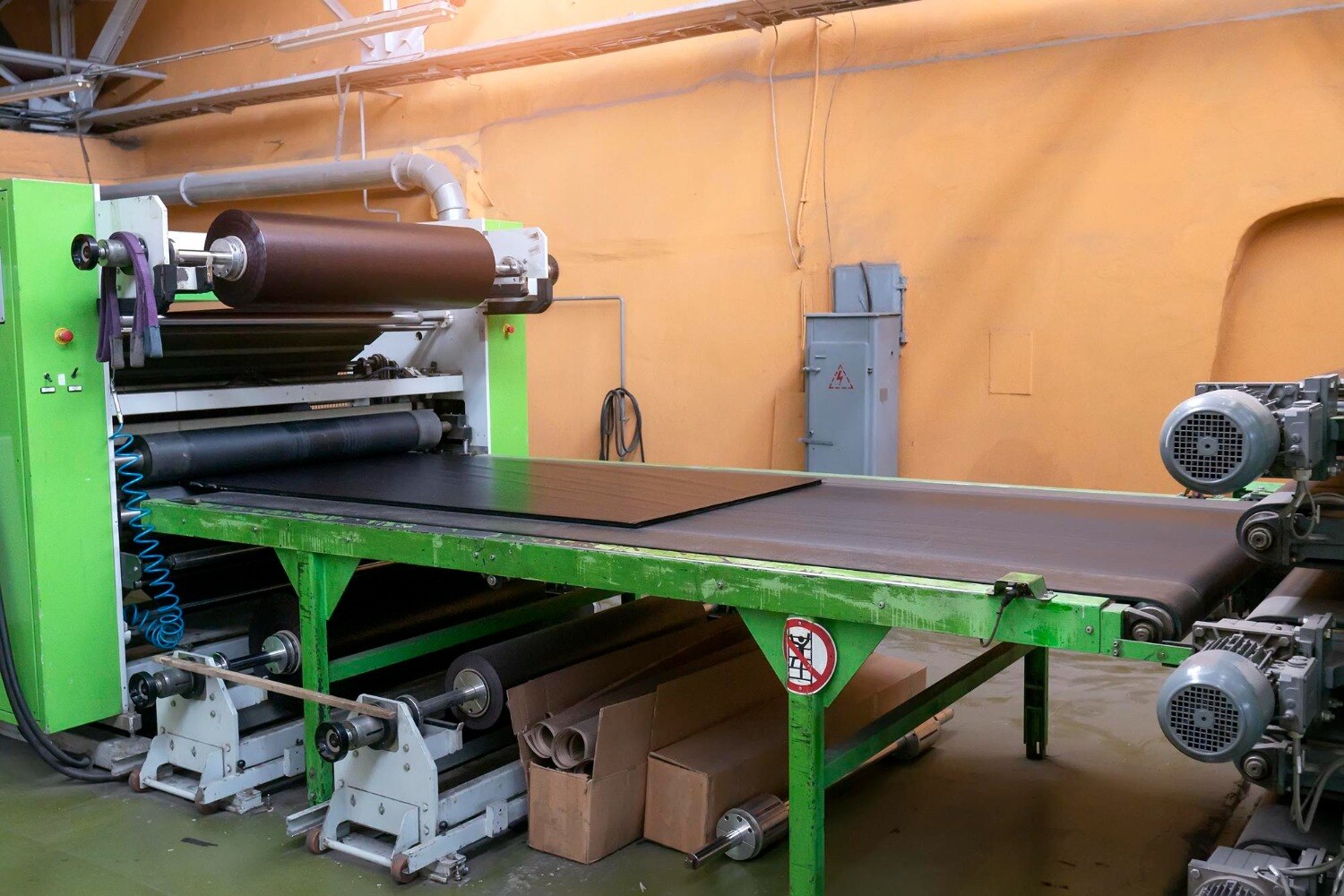
The right conveyor depends on whether each part reaches the printhead in the same position, at the same height and with the required motion profile. By the end, you will be able to define the fixture, printing method, indexing requirements, safety interfaces, ownership costs and supplier tests needed for a production-ready purchase.
Key takeaways
- Use a fixture when parts need fixed datums for repeatable print registration.
- Choose indexing for precise print cycles and continuous motion for higher throughput.
- Specify pocket clearances, sensors, reject handling and changeover requirements before quoting.
- Compare total cost, including fixtures, maintenance, downtime and supplier support.
Decide Whether Your Products Need a Fixture
Choose a fixture when the product cannot stay registered beneath the printhead by resting on the belt. A fixture printing conveyor uses a pocket, nest, jig or carrier to hold each part against defined datum surfaces.
This matters for irregular, unstable, small, curved, porous or mixed-orientation parts that can shift, roll, tilt or arrive at different heights.
| Product condition | Suitable conveyor | Main risk |
|---|---|---|
| Stable base, consistent dimensions, predictable orientation | Flat belt | Registration drifts if parts move or overlap |
| Irregular shape, curved base, variable orientation | Fixture conveyor | Extra tooling and changeover time |
| Small or unstable part needing a fixed print position | Fixture conveyor | A shallow nest may allow rotation |
| High format variation with manual loading | Flat belt or flexible nest | Fixture cost may outweigh its benefit |
A flat belt is sufficient when the base is stable and the print surface remains inside the required print window without mechanical location. Friction becomes unreliable with oil, ink overspray, dust or changing surface finishes, so treat an industrial printing conveyor as a locating-and-registration machine, not merely a transport belt.
Before choosing a fixture printing conveyor in Ghaziabad, record part length, width, height, mass, centre of gravity, allowable variation, orientation and overhang. Require the supplier to state the usable fixture envelope, fixture pitch, fixture-to-fixture clearance, fixture mass and maximum accumulated load. Also define the datum surfaces and repeatability required at the printhead.
Match the Conveyor Motion to the Printing Process
Choose the print integration before fixing conveyor speed. An industrial printing conveyor succeeds when its motion matches the printer’s registration method, not when its belt reaches a headline speed. A printing conveyor in Ghaziabad should be specified around the print window, fixture position and process cycle.
| Process | Motion and position requirement | Integration details |
|---|---|---|
| Inkjet or thermal inkjet | Defined print window and controlled product height | Set printhead stand-off, encoder feedback or trigger timing, and clearance for cartridges, cables and maintenance |
| Laser marking | Fixed focal distance and stable marking field | Provide beam enclosure or interlock arrangement and extraction where required |
| Thermal transfer | Controlled contact during marking | Define ribbon-head geometry and product support |
| Pad printing | Repeatable stop position and dwell | Provide platen clearance and enough dwell time for the pad cycle |
Stop-and-go indexing is easier to coordinate with a fixed printhead. A photoelectric sensor detects the fixture; the controller stops the conveyor, confirms position, allows settling, and sends the print trigger. Continuous motion supports higher flow only when the printer uses encoder-based speed compensation.
Specify:
- Line speed, throughput per minute and allowable product spacing
- Indexing accuracy, approach direction, stopping error and settling time
- Dwell time, restart behaviour and print window
- Encoder resolution or trigger timing
- Clearance for the printhead, cables, cartridges, guards and maintenance
Demand a takt-time calculation covering loading, indexing, settling, printing, curing, unloading and rejects. Test it with actual products and fixtures at planned speed; one successful print does not prove production registration.
Specify the Fixture, Controls and Defect Prevention Measures
| Fixture option | Best match | Trade-off |
|---|---|---|
| Deep pocket | Unstable or irregular parts | Strong restraint; slower cleaning and replacement |
| Shallow nest | Frequent format changes | Fast changeover; weaker anti-rotation control |
| Vacuum hold-down | Flat, sealed surfaces | Secure grip; requires vacuum monitoring |
| Side guides | Long, stable products | Simple location; limited height control |
| Locating pins | Defined holes or datums | Repeatable; needs accurate part features |
| Hardened stops | Repeated indexed stops | Durable; can mark soft surfaces |
| Quick-change plate | Multiple formats | Rapid replacement; higher tooling cost |
Add keyed or poka-yoke features so the wrong plate cannot fit. Mark every fixture with an identification code and link that code to the selected recipe; this prevents a shared line from printing one format with another format’s settings.
For pneumatic stops or clamps, specify force, stroke, response time, minimum and maximum pressure, pressure-switch confirmation, guided cylinders and behaviour on air loss. State whether the part must remain secured during a stop or power interruption.
A fixture printing conveyor in Ghaziabad must control belt tracking, vibration, product height, contamination, encoder slip and sensor position. Measure registration after the conveyor stops; a nominal speed figure proves nothing.
If UV curing is included, define lamp heat load, permissible fixture temperature, ventilation or extraction, belt temperature rating and access interlocks. Request guards at pulleys, chains, sprockets, rollers and transfer points, reachable emergency stops, and a defined stop response for the conveyor, printhead, clamps and UV source.
Specify motor ratings, drive, enclosure rating, control voltage, communication protocol, spare I/O, earthing and safety functions as separate line items for the industrial printing conveyor.
Compare Alternatives and Calculate the Full Cost
A high-speed belt is not automatically the higher-throughput purchase. Choose the handling method that preserves print quality at the required takt time.
| Option | Strength | Main limitation |
|---|---|---|
| Flat belt | Stable products with operator- or sensor-based orientation | Poor choice for rolling, overlapping parts or tight registration |
| Cleated conveyor | Inclines and fixed spacing | Cleats can obstruct the printhead or change product height |
| Chain conveyor | Pallets and heavy carriers | Pitch, vibration and transfer gaps can disrupt small printed parts |
| Rotary indexing table | Precise position and compact multi-station access | Less attractive for long flows or many product formats |
| Manual loading station | Avoids custom conveyor tooling | Labour, orientation errors and uneven cycle time become the handling cost |
| Fixture conveyor | Repeatable location for demanding parts | Difficult to justify with frequent product changes or manual pocket loading |
Compare the purchase price of an industrial printing conveyor with custom fixture tooling, printhead brackets, sensors, encoder, controls, guarding, installation, change parts, cleaning, calibration, spare belts, utilities and changeover downtime. Ask the fixture conveyor manufacturer to calculate how many fixtures keep the printer continuously fed through loading, indexing, settling, printing, curing, unloading and rejects.
Test throughput at the print quality you require, not at maximum belt speed. Manual loading can remain the bottleneck, while excessive speed can reduce curing dose or registration. A rotary or indexing system often integrates more easily with a fixed printhead; continuous motion requires encoder synchronisation and a printer designed for moving substrates.
Include the full takt-time calculation in the quotation.
Audit the Supplier Before Ordering in Ghaziabad
Freeze the site interfaces before fabrication. A layout drawing prevents a conveyor that meets its own drawing from failing at your floor, guarding or print station.
1. Ask every fixture conveyor manufacturer for a layout showing line height, transfer gaps, floor loading, anchoring, level tolerance, guarding, maintenance access, ambient temperature and site interfaces.
2. Require the quotation to separate the base machine from electrical cabling, compressed-air quality, UV extraction, exhaust, installation and commissioning. Ask for fixture drawings, speed and accuracy tolerances, load calculations, electrical I/O, sensor and encoder specifications, safety details, maintenance schedule, spare-parts list and commissioning procedure.
3. Before acceptance, run your actual product, fixture, ink process and planned production speed. At minimum and maximum speed, record print registration, fixture repeatability, stopping error, settling time, cycle time, reject rate, restart recovery, changeover time, noise and utility consumption during a meaningful production run.
4. Check cleaning access and confirm that belts, fixtures, guides, seals and cables tolerate your solvents, ink chemistry, UV exposure and curing heat. A mechanically suitable material can swell, crack or lose traction in service.
For a printing conveyor in Ghaziabad, ask Sunrise Conveyors to document installation responsibility, service response, spare-parts availability and operator training in the quotation. Approve the purchase only after the trial proves registration and handling performance.
Related product
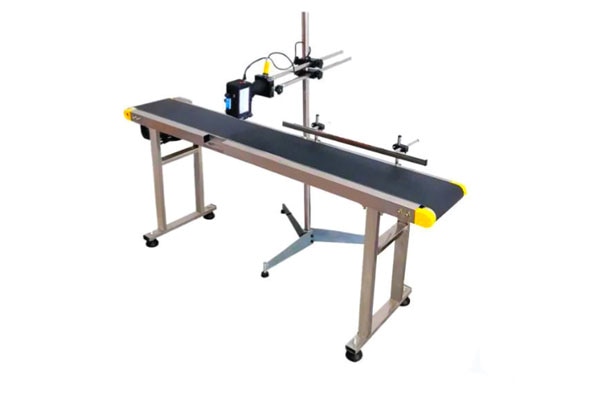 | Material Handling Equipment A print conveyor is a specialized conveyor system used in printing and packaging industries to transport printed materials smoothly between different... View product → |
Frequently asked questions
When does a product need a fixture printing conveyor?
Use a fixture when a part cannot remain registered under the printhead while resting directly on the belt. A pocket, nest, jig or carrier locates the part against defined datum surfaces and reduces print-position variation.
Which conveyor motion suits industrial printing?
Choose indexed motion when the printhead needs the product to stop at a precise location. Choose continuous motion when the process supports printing while parts move and throughput matters more than individual stop accuracy.
What should you specify for the fixture and defect prevention?
Define the part datums, pocket clearances, loading orientation, changeover method, presence sensors, print-trigger logic and reject handling. Include controls that stop or divert products when a fixture is empty, misloaded or out of position.
How should you compare fixture conveyor alternatives?
Compare the complete cost rather than the conveyor price alone. Include custom fixtures, spare carriers, tooling changes, operator loading time, cleaning, maintenance, rejected parts, downtime and future product changeovers.
What should you check before ordering from a fixture conveyor manufacturer in Ghaziabad?
Ask for a layout, cycle-time basis, fixture drawings, control sequence, guarding details, acceptance-test criteria, service response process and a list of customer references using comparable printing applications.
Keywords